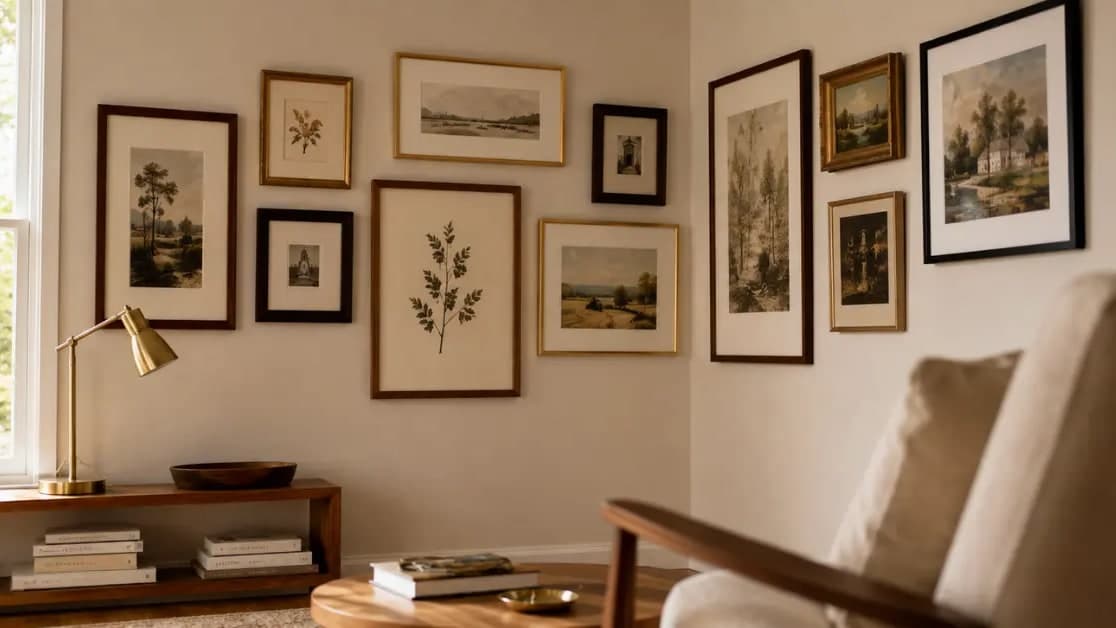
How to Create a Stunning Corner Wall Gallery: 16 Stylish Ideas for Every Room
August 05, 2026 · Lilac Pearls
Discover 16 corner wall gallery ideas for every room, from matching frame sets to floating shelves, plus tips for planning a balanced gallery wall.
Corners are some of the most overlooked spaces in a home. They sit between two walls, catch awkward shadows, and rarely fit standard furniture, so they often stay empty by default.
A corner wall gallery changes that. By treating the angle as an opportunity instead of a limitation, you can turn a wasted corner into one of the most personal spots in the room.
This guide walks through 16 corner wall gallery ideas for every room in the house, along with planning tips, common mistakes, and answers to the questions readers ask most often about gallery walls
Why Choose a Corner Wall Gallery?
A corner gallery makes use of space that would otherwise stay bare. Because corners are visually contained by two walls, art placed there often draws the eye more naturally than a single flat wall would.
Corner galleries also tend to require less wall space than a traditional horizontal layout, which makes them a practical choice for smaller rooms, rentals, and hallways where a full wall isn't available.
How to Plan Your Corner Gallery Wall
Start by measuring the full height and width of the corner, including a few inches onto each adjoining wall. This tells you how many frames the space can realistically hold without feeling cramped.
Next, choose one unifying element, whether that is frame color, mat style, or subject matter. That single thread is what keeps a corner gallery looking planned instead of accidental.
Finally, lay the arrangement out on the floor or trace paper templates onto the wall with painter's tape before drilling anything. Corners hide studs at inconsistent spacing, so a test layout saves time and unnecessary holes.
17 Corner Wall Gallery Ideas
Each idea below works as a starting point rather than a strict rule. Mix and adjust based on your own corner, furniture, and collection of frames.
1. Wrap Around the Corner with Matching Frames
The simplest way to turn an awkward corner into a focal point is to wrap it with matching frames. Choose one finish, one mat style, and let the frames continue naturally from one wall onto the other.
This approach works especially well for renters or first-time decorators because it removes the guesswork. A single frame set already comes in coordinated sizes, so the layout almost designs itself.
corner wall gallery matching frames
2. Create a Floor-to-Ceiling Gallery Display
Corners with high ceilings are often left empty simply because they feel too tall to decorate. Running a gallery from floor to ceiling solves that problem by treating the height as an advantage instead of a challenge.
Start with larger frames near eye level, then gradually shift to smaller pieces as the display climbs upward. This keeps the arrangement readable instead of overwhelming.
floor to ceiling corner gallery wall
3. Design a Minimalist Black-and-White Gallery
A black-and-white palette keeps a corner gallery feeling calm even when several frames are grouped closely together. Because every piece shares the same tone, the eye can rest instead of jumping between competing colors.
This idea suits bedrooms and home offices particularly well, since a quieter palette supports focus and rest rather than visual noise.
minimalist black white corner gallery
4. Mix Vintage Frames for Timeless Charm
Vintage frames rarely match perfectly, and that is exactly what makes them work in a corner gallery. Combining an arched frame, a beaded edge, and a simple rectangle creates the feeling of a collection built over time rather than purchased all at once.
To keep the mix from feeling chaotic, stay within one or two metal tones, such as antique gold and dark bronze.
vintage frame corner wall gallery
5. Style a Botanical Print Gallery
Botanical prints bring a corner to life without relying on personal photos or bold colors. They work particularly well near a window, where natural light and real greenery reinforce the theme.
Choose prints with a similar illustration style, whether that is detailed botanical line drawings or soft watercolor florals, so the collection reads as one idea rather than several unrelated pieces.
botanical print corner wall gallery
6. Combine Floating Shelves with Framed Art
Floating shelves add a practical layer to a corner gallery, since frames can be leaned and swapped without new nail holes each time. Layering a small shelf beneath a cluster of hanging frames also adds shallow depth, which makes the corner feel more dimensional.
Leave a little breathing room on each shelf. A shelf packed edge to edge tends to look cluttered rather than curated.
floating shelf corner wall gallery
7. Pair a Mirror with Wall Art
A mirror placed beside or above framed art bounces light into a corner that might otherwise stay dim. It also breaks up a gallery visually, giving the eye a place to pause between groups of frames.
Choose a mirror shape that contrasts gently with the surrounding frames, such as an arched mirror among rectangular art, so it stands out as an intentional accent rather than getting lost.
mirror and art corner wall gallery
8. Create a Reading Nook Gallery Corner
A reading corner benefits from artwork that feels calm rather than eye-catching, since the goal is to settle in rather than be distracted. Pair a small gallery with a floor lamp and a comfortable chair so the whole corner functions as one cohesive space.
Keep the frames slightly lower than eye level here. Readers usually look at the wall while seated, not standing.
reading nook corner wall gallery
9. Decorate an Empty Staircase Corner
The corner where a staircase meets the wall is often left bare because the angled wall feels tricky to plan around. Following the angle of the stairs with a diagonal frame arrangement actually makes the space easier to fill, not harder.
Measure twice before drilling here. Staircase walls hide plenty of studs at inconsistent heights, so a paper template saves real frustration.
staircase corner wall gallery
10. Build an Inspiring Home Office Gallery
A corner behind or beside a desk is prime space for a gallery that keeps you motivated during the workday. Mix a favorite print with a small shelf for a plant or a framed certificate, so the corner feels personal rather than generic.
Avoid hanging anything directly behind a video call camera unless it is intentionally part of your on-screen background.
home office corner wall gallery
11. Display Your Favorite Travel Memories
A travel-themed corner works well in a hallway, where guests naturally pause to look. Combine framed photos with a small map print or a ticket stub shadow box for texture beyond flat photographs.
Group memories by trip rather than by frame size. It keeps the story of each place easy to follow at a glance.
travel memories corner wall gallery
12. Style a Gallery Above a Console Table
A console table anchors a corner gallery visually, giving the eye a clear starting point before it travels up to the frames. Keep the tabletop styling simple, such as a lamp and one small object, so it supports the gallery instead of competing with it.
As a general rule, leave six to eight inches between the top of the console and the bottom row of frames.
console table corner wall gallery
13. Keep It Modern with Neutral Artwork
A neutral, modern corner gallery relies on simple shapes and a restrained color palette instead of pattern or ornamentation. Abstract line art and soft-toned landscapes both work well here, as long as the frames stay thin and understated.
This idea suits open-plan living rooms especially well, since a neutral gallery blends with almost any furniture style already in the room.
modern neutral corner wall gallery
14. Add Personality with an Eclectic Gallery Wall
An eclectic corner gallery embraces variety on purpose, mixing photography, illustration, and small wall objects like a woven hanging or a ceramic plate. The key is a shared thread, whether that is color, subject, or era, that ties the mismatched pieces together.
Lay everything out on the floor first. It is much easier to adjust spacing before anything goes on the wall.
eclectic corner wall gallery
15. Make the Most of a Small Apartment Corner
Small apartments often have the tightest, most awkward corners, which makes them a natural fit for a gallery instead of empty wall space. Stick to lightweight frames and removable adhesive hooks if a lease restricts drilling.
A tighter frame cluster with narrower gaps tends to suit small corners better than a spread-out arrangement, which can make a compact room feel busier than it needs to.
small apartment corner wall gallery
16. Create a Bold Statement Gallery Corner
Sometimes a corner deserves to be the boldest spot in the room. Deep colors, oversized frames, and a single dramatic art piece can turn an overlooked corner into the first thing guests notice when they walk in.
Balance boldness with restraint elsewhere in the room. A statement corner reads best when the surrounding walls stay simple.
bold statement corner wall gallery
Best Rooms for a Corner Gallery Wall
Living rooms and entryways tend to be the most natural fit, since both spaces already draw attention as soon as someone enters. Hallways and staircase landings are close behind, especially for travel or family photo themes.
Bedrooms and home offices work well too, though softer palettes and lower placement usually suit those rooms better than bold, high-contrast arrangements.
Designer Tips for a Balanced Gallery Wall
Keep two to three inches between frames for a cohesive cluster, or four to six inches for a more relaxed, spaced-out look. Consistency in spacing matters more than the exact number you choose.
Hang the visual center of the gallery at roughly eye level, around 57 to 60 inches from the floor, then build the rest of the arrangement around that point.
Vary frame sizes rather than repeating the same dimensions throughout. A mix of large, medium, and small pieces creates natural rhythm across the corner.
Common Mistakes to Avoid
Hanging everything too high is the most common mistake, especially in a corner where the angle already makes height harder to judge. Use a paper template at eye level before committing to nail holes.
Mixing too many unrelated colors or styles without a unifying thread is a close second. A gallery can be eclectic and still feel intentional, as long as one consistent element ties it together.
Overcrowding a small corner is another frequent issue. Leaving a little breathing room around the edges of the arrangement almost always looks better than filling every available inch.
Frequently Asked Questions
What are some easy corner decor ideas?
A matching frame set, a single floating shelf, or a small mirror paired with one or two prints are the easiest ways to fill a corner without a complicated layout.
How to do a simple gallery wall?
Choose one color palette, lay the frames out on the floor first, and start with the largest piece near eye level before adding smaller ones around it.
What are common gallery wall mistakes?
Hanging frames too high, spacing them unevenly, and mixing too many colors or styles without a shared thread are the most frequent mistakes.
What can I put in a corner wall?
Framed art, a floating shelf, a mirror, or a small combination of all three all work well, depending on how much space the corner offers.
How to decorate a useless corner?
Wrapping a matching frame set around the angle, or adding one floating shelf with a couple of leaning frames, is usually enough to make an awkward corner feel intentional.
What makes a great gallery wall?
A great gallery wall has a clear visual thread, whether that is color, frame finish, or subject matter, along with balanced spacing between each piece.
Conclusion
A corner wall gallery is one of the simplest ways to bring personality into a room without needing a full wall of empty space. Whether you choose a matching frame set, a floating shelf, or a bold statement piece, the goal is the same: turn an overlooked corner into a spot you actually enjoy looking at.
Start small if you're unsure. A single shelf or a three-frame trio is easy to expand later once you see how the corner feels in daily life.